Showing posts with label hormones in milk. Show all posts

Monday, September 11, 2017

No hormones are added to your milk.

Image may contain: 1 person, smiling, outdoor and nature


Twice this weekend I was asked the same question – are there added hormones in milk?

I’m happy I could give the answer – no!  There are no added hormones in milk.  Not in conventional milk nor in organic milk.

First of all, in Michigan, farmers don't give their cows hormones to help them produce more milk. (We never have on this farm, either.)  When farmers did it in the past, there was no way to tell the synthetic hormone from the natural hormone, because cows already produced it.  (So there was no test for it.)  But when consumers didn't want it, farmers stopped using it.  In Michigan, that happened in 2008.  The rest of the country has done the same.

All milk - organic and conventional - has natural hormones, because it is coming from a lactating mammal.  But!  Never fear because ...

Humans do not have receptors for bovine hormones.

It's not me saying it - it's scientists.

Dr. Terry Etherton: “There are zillions of protein hormones in both plant and animal foods. They are digested in the stomach, which kills their ability to have any biological activity." Best Food Facts

Another way to put it, from Science Blogs: Aetiology by Tara C. Smith, is:

“Studies have shown that human and bovine milk normally contain small amounts of growth hormone. After ingestion, growth hormone as any other protein in milk: it is digested into its constituent amino acids and di- and tripeptides. There is no data to suggest that BST present in milk can survive digestion or produce unique peptide fragments that might have biological effects.

Even if BST is absorbed intact, the growth hormone receptors in the human do not recognize cow BST and, therefore, BST cannot produce effects in humans. … Overall studies show recombinant growth hormone cannot be absorbed intact through intestine and even if small amounts get absorbed, there is no receptor for bovine growth hormones in humans.”

Or from the American Cancer Society:

"Neither natural nor synthetic BGH has been found to affect human growth hormone receptors."

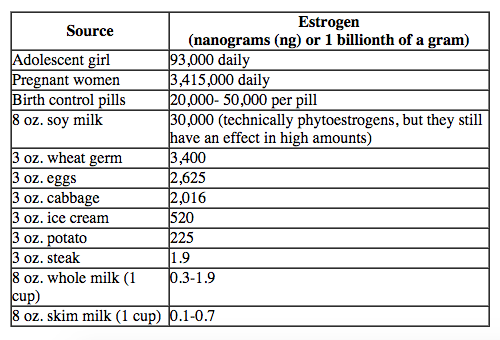
Let me also add that these are naturally-occurring hormones, which all milk has, because it comes from lactating animals.  Hormones aren't just present in milk - they're present in all types of food. For instance, look at this chart about estrogen from Allen Young, Utah State University Extension dairy specialist and associate professor:
Screen Shot 2014-11-10 at 9.09.21 PM
                                               
So there’s your milk news for the day.  Please feel free to ask any questions you have!

Other questions answered:

What's the difference between whole, 2% and skim milk?

How long can you drink milk past the sell-by date?

Does milk make girls develop faster?  No.

What's the difference between organic and conventional milk?  Process, not product.

Why does organic milk have a longer expiration date?  It's heated up hotter.

and...

There are no antibiotics in your milk.

This is what we do to guard against human error to never have antibiotics in milk.

GMOs, no antibiotics, etc.


Tuesday, February 9, 2016

Does milk make girls develop faster? No.


Does milk make girls (or boys) develop faster?

I commonly get this question about modern milk – does it make girls hit puberty earlier?  Does it affect growth?  I actually get it more as a statement, like “We don’t drink milk because ... you know what it does to girls.”

As common as this is to hear, I have good news – it’s not true.   

Best Food Facts is trying to dispel this myth.  Check out this excerpt:

***

“We’ve heard literally dozens of women discuss their concern with hormones in milk causing early puberty. In focus groups near Chicago and New York City, when we asked moms what concerns they have about today's food, the topic of early puberty due to "hormones in milk" came up several times. The women expressed that they know girls who have started menstruation earlier than they thought was normal. News articles including The New York Times and The Huffington Post have discussed it. Foodie moms, farm moms and nannies are blogging about it.

Clearly, this is a scary scenario for parents – certainly one for which we wanted to help find some credible information. To get the facts, we enlisted the help of Dr. Ann Macrina, research/teaching associate, and Dr. Terry Etherton, animal nutrition professor, both of Pennsylvania State University.

BestFoodFacts: There seems to be growing concern about the association between hormones in dairy products and early puberty in girls. What are your thoughts on this concern?

Dr. Macrina: “The age at which puberty begins in girls has been decreasing since the mid-1800s. It is odd to blame it on dairy products since dairy consumption has actually decreased during the same timeframe. Several things have been cited as causing early puberty in girls:  

·     Girls are maturing more quickly because they have better nutrition.

·     Many believe girls must achieve a certain body mass for the onset of puberty to occur. The obesity rate is increasing in this country at a rapid rate and girls are reaching this point much sooner.
  
·     Ethnicity might play a role. African-American girls and girls of Hispanic heritage tend to reach puberty sooner than Caucasian girls."

“There are many contributing factors to be considered but I don’t think dairy consumption is one of them.”

Dr. Etherton: “There are zillions of protein hormones in both plant and animal foods. They are digested in the stomach, which kills their ability to have any biological activity. There is just no way to come to a science-based conclusion that hormones in food or dairy products cause early puberty.”

***

I want to stress – hormones in the stomach are digested and this “kills their ability to have any biological activity.”

Let me also add that these are naturally-occurring hormones, which all milk has, because it comes from lactating animals.  Hormones aren't just present in milk - they're present in all types of food. For instance, look at this chart about estrogen from Allen Young, Utah State University Extension dairy specialist and associate professor:


Another way to put it, from Science Blogs: Aetiology by Tara C. Smith, is:

***

“Studies have shown that human and bovine milk normally contain small amounts of growth hormone. After ingestion, growth hormone as any other protein in milk: it is digested into its constituent amino acids and di- and tripeptides. There is no data to suggest that BST present in milk can survive digestion or produce unique peptide fragments that might have biological effects.

Even if BST is absorbed intact, the growth hormone receptors in the human do not recognize cow BST and, therefore, BST cannot produce effects in humans. … Overall studies show recombinant growth hormone cannot be absorbed intact through intestine and even if small amounts get absorbed, there is no receptor for bovine growth hormones in humans.”

***

I think that's a great way to put it: "there is no receptor for bovine growth hormones in humans."

Cows ... people ... our bodies are different inside and out!


So!  Cheers to milk.  It has nine essential nutrients, it tastes good, and our cows are making it every single day. 

There are lots of things to worry about when raising kids, (and feeding yourself), so let this one go. I'm going to go back to worrying about how to teach my kids fractions, since that seems way more complicated than puberty.


Want to know more about the farm?  Like the page on Facebook, on Twitter @carlashelley, or sign up to get the blog by email - the form is on the right side of the page.

Any questions?  Email me.