Tuesday, January 29, 2013

Icy creek

So ... it was super cold, it snowed, it iced.  Then today it warmed up to 59 degrees and everything melted. 
 
The creek looked super swollen and so the boys and I went for a walk to look at it.  The ice chunks were all jammed up at the culverts under the road.  We watched the ice floes come down and crash into each other.  There was a lot of noise.


And ... do you see?  A little spot of color in the middle.


A beach ball.  A beach ball in our little creek, going for a ride.

I asked where they wanted to walk, and my son Cole said, "Let's go to the young barn."  We laughed and he said, "I meant the new barn.  I couldn't think of its name!"  (So there's another barn name option!)

It's so muddy.  The ground is frozen and it can't soak up the water fast enough.  Everything is a mess. 


We made our way over to the old barn because they wanted to see how it looked with all the hutches taken out.  It was getting dark, so I'd turned on the lights.  When I was leaving I went to flip off the switch, my finger touched the metal switch plate - and I screamed!  It gave me a really big electric shock!  And it is a shock when you get shocked.  This one really sizzled!
 
I asked Kris about it later and he said that it's always that way ... especially when you're standing in water, like I was.  I mentioned it to my dad and he said, "It's always been that way.  Try it when you're holding onto the metal pipe there AND accidentally touch it.  THAT'S a shock!"
 
At home Kris asked me if I'd gotten a haircut.  I hadn't.  I think it just was standing straight out from my head, cartoon-like.

Saturday, January 26, 2013

What are we going to call it?

Kris and I were discussing something about the farm, and I didn't know which barn he was talking about.  
 
I said we should agree upon a name to call the yet-to-be-built free stall barn.  We can't call the old free stall barn 'the old barn' because we already have an old barn.  And we can't change the name of the original old barn because I've called it that my entire life.  It'd be like changing the name of one of our kids suddenly because we had another one.  (Okay, maybe not that dramatic, but that was my reasoning with Kris.) 
 
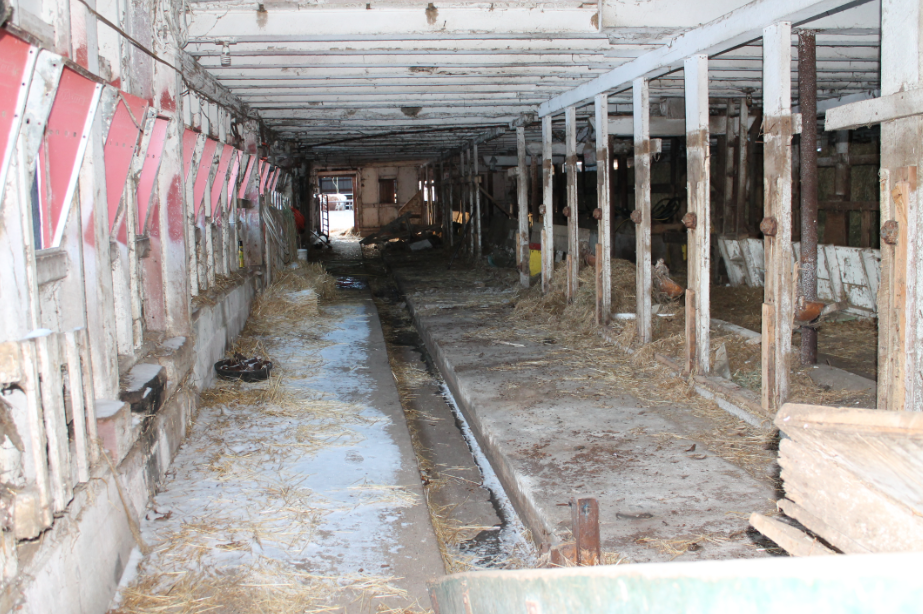
Kris said the old barn could be called the old calf barn OR the old milking barn.  Now it's the storage barn.  The guys have been working on taking out all of the old calf housing in order to be able to store hay and straw bales in it. 
 
Here's what it looked like when we housed calves in there three years ago:


Here's what it looks like today.  This used to be where the cows were milked - at first, with my great grandpa.  Then we put in the hutches - my dad's time.  Now the hutches are gone again -


Here's a picture of the new calf barn, as of last year:


Over the time of the farm, the barns get all different uses.  Whatever fits the farm and the fashion of the day!  When I went out to take the pictures of the new barn, this is what I saw in the sky.     
 

X marks the spot.  Here we are, here we've been, here we'll stay.  No matter what we call it.

Wednesday, January 23, 2013

Skating rink

It's been cold here the last few days.  For instance, it was -5 two nights ago.  I had the boys go outside to feel what it felt like, because it's not often this cold.  So today when it warmed up to 16 degrees, it already felt fine.  It's funny how quickly you adjust to whatever weather you have. 

I'd mentioned going ice skating and Kris reminded me ... for a short while we have our own ice skating rink!  The manure lagoon collected a little bit of water in it and is, of course, frozen.


This will not be repeated when it's actually filled with manure.  (Unless it turns out my kids are really good at hockey ... you know how hard it is to get rink time.)


The cold creates problems around here - some piping froze in the calf barn utility room and we had to repair that.  A couple of the teat dippers froze the first cold morning.  The molasses pump, Kris said, seems to be struggling with the cold.  Slow as molasses, naturally.

After we slid around the ice, we watched the excavator work on the free stall barn area. 


We watched until our faces were numb.  Score another one for technology - the low temperatures didn't seem to bother the giant machines at all.

Tuesday, January 22, 2013

Small community

How small is the dairy farming community?

Well, the figure quoted at meetings is that there are 50,000 dairy farms in the country.  That doesn't exactly mean that there are 50,000 farmers, because there are often multiple farmers per farm. 

(The other day my son started to run in a parking lot and I said, "If you run without looking in a parking lot you're going to get hit by a car and die.  And it's my job to keep you alive!"  Cole replied, "Your job is a dairy farmer.")

The dairy community seems small.  I see the same people at Farm Bureau meetings and National Milk meetings.  Now that we've been doing this for awhile we know a lot of people in Michigan.  And!  Today I realized that one of my favorite articles in Hoard's Dairyman is where they do roundtable answers with four farms. 

Why?  Because I usually know someone in it!  Today I looked at the smiling face of our friend, Jerry Link and his relatives.  It makes it even more interesting to read the answers when you know the people.

It's like that with a lot of the farm magazines.  There are only so many people to write about and so many farms to photograph.

But there will soon be more ... we know a guy who's starting up his own, new dairy next year.  Hopefully, he'll be interviewed about it.  Lucky number 50,001.

Monday, January 21, 2013

Milk, museums, milestones

I was at a friend’s house today and her husband told me how he’s potty trained his three daughters.  (Starting on the fourth daughter.)  He said, “ I just put them on a potty in front of the TV, give them three glasses of chocolate milk, and there you go.  It always goes smoothly.”

Yet another amazing use for dairy – potty training tool.  Just as catchy as ‘Got Milk.’

***

We went to the Michigan Historical Museum and they had a farm section.  Part of it was about the use of silos:


It says, "Silos changed the appearance and practices of Michigan farms during the early 20th century.  Farmers stored finely chopped crops - feed for their cows - in these new farm structures.  The ability to store feed allowed farmers to increase their dairy herds.  Silos of the 1920s were built of masonry, brick, steel, cement or wood stave, concrete block or glazed tile."

They even had a little pretend barn and silo:


It reminded me of when I brought a city friend home from college.  She asked, “What are those big tall things called?”  I was surprised she’d never heard the word 'silo', but … maybe if she’d visited this museum it would have been different.

***

And last but not least, the builders are planning to start on the barn this week or the next!  It’s frozen here – high of 12 degrees today – but apparently they can still put in posts and begin.  Here we go! 

Friday, January 18, 2013

Fixes

This morning when I woke up Kris was gone - way earlier than he normally goes.  I texted him to see what was wrong.  Nothing!  I'd forgotten that the mechanic was coming to work on the wheel loader today and Kris wanted to use it to feed the cattle before he got here.  A planned early morning is always better than a rushed get-out-of-the-house-something-is-wrong early morning.

It's a hydraulic leak.  Now, I'm sure you're thinking - wasn't there a hydraulic leak in the wheel loader before?  If so - CONGRATS!  You have a great memory.  (If anyone remembered, it'd be our former co-workers at Caterpillar, since it's a Cat wheel loader.)  And the answer?  Yes.  It's the same leak.  The mechanic thought he fixed it before, but it didn't work. 

The heifers got into the wrong field again, but we were able to fix that ourselves!  The heifers kept going back into the woods, but then when they wanted to go back to the feeder, they couldn't figure out that there was a jog in the fence.  They would see cattle where they wanted to go, so they would just go straight through the fence to get there.  After this happened a few times, Kris decided he would stop trying to train them, and just move the fence posts so there was no jog.  I guess it's possible to teach a young heifer new tricks, but it's far simpler to just move the fence posts to accommodate their travel paths. 

We've had a fairly strange week here - a pig farmer accidentally destroyed my toe by sitting on it with his metal stool, my baby niece had a seizure while we were caring for her and we called 911, my sister had a retinal migraine which made her lose sight in one eye and really scared her, the engineering firm working on our lagoon dissolved ... but the good news is, everyone and everything is okay! 

Let's hope the fixes next week are as easy as moving fence posts.

Monday, January 14, 2013

Righting the wrongs

This morning I was listening to The Bob & Tom Show and they were talking about a guy who robbed a store with a cattle prod.

The people on the show know very little about farming (I know, I've listened to them for a long time) and they started to talk about how cattle prods are inserted into cattle in order to encourage them to move. 

Quickly, I fired off an email to them. It read:

Cattle prods are NOT INSERTED.  They give a tiny shock. 

From a dairy farmer,
Carla Wardin

I turned off the radio. and got busy doing other things.  A few minutes later my friend Suzie called and said, "This might seem like an odd question, but did you just call into a radio show?  They said something about Carla the dairy farmer, and I thought - what are the chances?"

Kris got home later and said he heard it too.  I listened to it on the Bob & Tom site and Tom said, "I want to clarify a couple things - cattle prods.  A guy robbed a convenience store apparently with a cattle prod.  It does not have to be inserted ... Carla is a dairy farmer and she just wanted to clarify."

Success!  The public obviously cares about farm practices and the idea that cattle prods are for insertion ... my goodness.  We don't need that kind of bad press.  Farmers take care of their cattle!  A cattle prod gives a tiny electric shock (like the level of an electric fence), and it's certainly not something used in common practice.  It's used as a very last resort when a cow doesn't want to get up after having a calf.  Sometimes the shock will make her stand, and standing equals recovery.  If she won't get up, she won't recover.  But certainly not inserted, ever.

Got that, radio nation?  Get the farming stuff correct, or I will be forced to WRITE YOU EMAILS IN ALL CAPS.